Tuesday, October 17

Latvia: a few days in October


One of the first things you notice about Latvia is that you can see a long way, there are lots of trees, usually in the distance and everything is very clean and tidy.


They also like green, and odd shades of green. This is a library and an apartment block in Juanjelgava.


Here in the main street of the small town old timber houses still stand. The pavement and roads are all clean and fresh with many Latvian flags flying but the old buildings seem to lack that element of pride in external appearance found across the old Soviet countries.


At one moment the sky is blue and then, not much later . . .


October rain clouds appear.

On our visit, rain was forecast for all day, every day, from 4 - 12 October. However, as the photos will show as we go through our travels, there was actually very little rain in the day. Most fell at night or late afternoon / evening and we seldom had to shelter or use windscreen wipers! We might have just been lucky but the Latvia we experienced was cool and crystal clear.


It's not easy to stop on Latvia's main roads. They have wide grass verges but slightly lower and I could never be confident of getting back on the tarmac again if I did decide to stop. Instead I found it simplest to wait for a convenient bus stop to check a route or look around. It was the same if you took a wrong turning; the road may be dead quiet but not quite wide enough to make a three- or, more likely for the bigger car we had hired, seven-point turn safely. There were turns but all at right angles into small vehicle-wide unmade tracks which, again, prevented a chance to turn back. Often we finished up in some woodland where we finally found a place on the track to make a turn!

There are many parks and all seem well-organised and attractive to tourists. Above is a park near Gauja where there are many well-marked pathways (and the only car park where we had to pay to park). The toilets at every place we stopped were excellent, even those plastic portable box types seem to be regularly cleaned and kept nicely. Those in fuel stations were amazing, compared to the dreadful facilities we're used to here in Britain.


The Gauja river looks muddy but I am not entirely sure why. It looked pretty clear to me at the time.


This particular park also had a cable car running from the nearby town across the huge forest.


Autumn had just stared to produce some colours other than green.


Latvia has lots of castles.


Every view seems dominated by trees.


A path in a forest near Koknese. More trees, of course.


The Daugava river is impressive and runs from Riga right across the country. Almost the whole of its length provides beautiful scenery.


There is plenty of room for people in these places. Nowhere did we find annoying bodies spoiling the view, nor litter of any description at all.


Old castles in varying degrees of dilapidation or rebuilding are open to clamber around, with plenty of those classic 'frames' for photos!


The blue skies continued to defy the predictions of rain.


In many parks or park-like spaces artists have erected timber structures.


Riga old town. All the streets are cobbled. Clean buildings here of classic design.


Jurmula is the seaside resort close to Riga. A very long and attractive beach.


On our visit the wind was more like a gale and it was all we could do to stand vertical. Huge waves like this are rare.


We had come down this stairway from a nice apartment block but getting back up was not quite as simple.


We had planned to visit Rundale Palace Museum but caught a glimpse of this place near Bauska on the way.


This was a marvellous castle that had been very recently opened, with much very clever and sympathetic reconstruction.


Inside there were rooms galore at every turn, some with displays which would not have been out of place in a museum in England, some that were just empty but with splendid windows and views.


Outside there were yet more cellars and rooms to search round.


Remarkably, it was possible to reach the very top of the tallest tower.


This is the Lielupe River, another wonderfully attractive river flowing straight through forests galore.


The journey back was interesting to say the least. My TomTom navigation device suggested the yellow route, some 120+ km. Google said take the pink road, nice and direct and only 50km. Whilst I understood that the shorter route might not be as fast and probably a lot more twisty, I preferred this to what might just have been a tedious normal road back.

Very shortly after leaving Bauska we encountered a sign to say that the surface might be uneven for 2.9km. It was a bit bumpy but just an unsurfaced road with a few potholes so nothing that seemed too bad. Once the 2.9km was done, however, another sign announced another 3.3km of the same. And so it continued! Not only was the surface getting worse but heavy rain earlier in the area had led to the potholes filling with water so you couldn't be sure how deep they were. Some holes stretched across most of the road and you did just have to hope that the water wasn't too deep.

The car I'd hired was a new Toyota Corolla with a pretty but very vulnerable front spoiler and it certainly was not the ideal car for this kind of trek. So we had to approach the unknown holes very gingerly to ensure that there was some chance of the tyres remaining inflated and wheels vaguely round in shape and suspension and steering bushes staying intact. At one point a huge lorry with a trailer, both laden high with timber, passed me which will give you some idea of my pace.

Most of the journey was spent on the wrong side of the road or wending left and right in search of some vaguely manageable surface but we only met a couple of cars going in the opposite direction so no trouble there. At Valle we crossed the P73 which was tarmac and much more pleasant-looking. However, the sign saying an uneven surface for the next 3km might just have been telling the truth so we carried on, firmly believing that there was no way the whole of the next 20km would be as bad. They were but we made it and the delight on finding some lovely smooth grey tarmac near Juanjelgava was great. We would have celebrated with a few drinks had we had any to hand.

Next time I shall hire a Jeep-like vehicle. Whilst the main roads are really excellent, there are many, many interlinking tracks which look like they're main roads on the map but actually are just tracks.


A smooth track - but not all are like this.


The other side of the river Daugava from Juanjelgava has some beautiful scenes.


In the summer, boats are available for rent or travel from either side of the river.


An arboretum on this northern side of the river is a peaceful and pretty place to visit.


Another castle was here once too.


You'll see plenty of these churches - a noticeable design and colour scheme which makes them appear quite modern when they may date back hundreds of years.


Latvia, a truly photogenic country.

One war might end another

I felt I had to write about what is happening in and around Israel in my last article. I felt that I should support Israel but I think like many people I wasn't too sure that Israel was good and Hamas were bad and that Israel could also be bad too if they wanted and that there was a good chance they'd be very bad indeed to the Palestinian people rather than just Hamas people and that would be difficult to justify. After listening to some interviews and reading some articles, however, I felt much more confident and able to write as I did.

With a much better understanding of the Soviet Union's history and Ukraine, I have been writing for many months about the terrible things that have been happening in Ukraine, hoping each time that there might be some glimmer of light for the good people of that nation. So far it has just remained very gloomy. Ukraine has made some advances in the South and steadily troubles Russian sites here and there by hitting planes, equipment or significant buildings but they haven't managed to pull off those decisive hits or advances which could bring the end-game closer.

Russia appears to have an endless supply of bodies to put into the fight. They are predominantly pretty useless and little more than bodies but sufficient to absorb enough of Ukraine's bullets and attacks to make progress slow.

With supplies from Iran and North Korea now getting through and increasing for Russia, our support and supplies seem to be at best level but probably starting to dwindle for Ukraine. Certainly the new Israel - Hamas war has taken almost everyone's focus away and the West are now wondering just how much more they can help Ukraine when they may be soon need to be ready to assist Israel in the escalating war in the Middle East.

All we need now is China to decide that it is a good time to make a move on Taiwan - maybe just a blockade or two but enough to divert enough of our ships and forces to permit someone else to advance elsewhere. A really determined effort by Russia to get a grip on Kiev, a strike by Iran on Israel, an accidental launch of a North Korean missile . . . any of these actions now seem feasible and would almost certainly be of benefit to Russia and the anti-Israel cause as we would simply bluster and say what we'd do but not actually do anything.

Even if there is no big 'success' for Russia I fear there is even less chance of any big 'success' for Ukraine (unless Israel feel inclined to give them a hand with some air power while their up in the sky). I do hope that Israel does give Hamas, and, if necessary, Hezbollah and Iran a bloody nose in the very near future as that will demonstrate that someone we support is prepared to say enough is enough and actually take some action.

Should such action lead to response which we are unable to ignore either contractually or morally then perhaps, at last, we too will have a chance to give Russia a kicking and send those pathetic bodies back home where they will be needed to help Syria or some other god-forsaken place in that awful area.

I have this feint hope that the Middle East war that is going to start, if it hasn't already, will help clear the air over Ukraine and give them some hope and a chance to reassert their borders after all. If Britain is drawn into battles with enemies of Israel then, whilst all hell will let loose, one does get the impression that Ukraine will come out of the winter stronger and better-supported and better-protected for 2024.


Just what is Palestine?

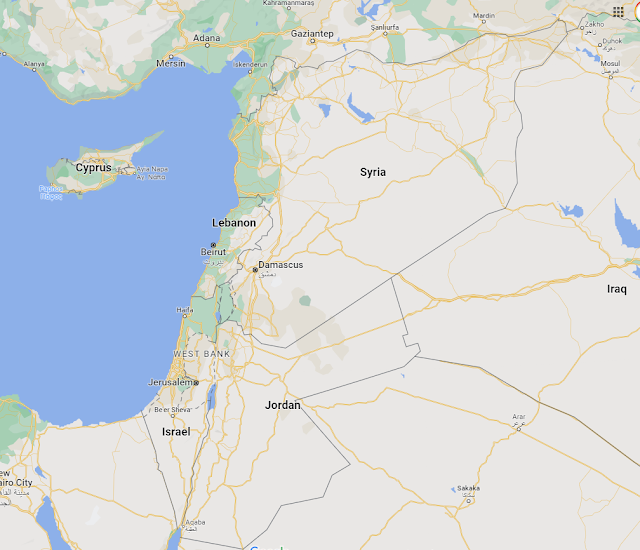
I wish I had paid more attention in History and Geography classes at school. If you asked me to draw an outline of Israel, Syria, Iran, Lebanon, Iran, Iraq, Jordan . . I would get none of them right. I might have got them in about the right area on that eastern bank of the Mediterranean Sea but that's about as good as it gets and I have no idea where Palestine is. Here's a map to help anyone as poorly informed as I am. 


This is a bad area and seems to be where trouble has always been brewing. I can't remember a time when something bad wasn't happening in this area. Now things really are looking grim after the most awful attack by Hamas terrorists from Gaza which killed over 1400 people in Israel, shocking, deliberate execution of civilian men, women, children and even babies which breaks every rule in the book of decency. Unsurprisingly, Israel has hit back and, as I write, everyone seems to be saying they should be careful not to overreact, start a regional conflict, World War III and so forth. No-one appears to have suggested that Hamas might have given some warning of their proposed attack or consider whether it was reasonable to shoot people who were simply having a meal with friends or celebrating at a music festival, or chop down someone running away, or take children hostage, parading mutilated bodies of girls in the back of trucks as they drove through town almost unchallenged. 

There seems to be an underlying dislike of Jewish people and, whilst I don't think Israel is home to Jewish people alone, this translates to simply disliking Israel. I read about this in places far and wide - from Labour Party troubles with historic antisemitism in its ranks to bad treatment of Jewish people in some neighbourhoods of London, to say nothing of some organisations which appear to believe that Israel shouldn't even exist and, of course, we should all be aware of the appalling atrocities carried out by Germany's Nazi forces and sympathisers in World War II. Following recent events, many national leaders have made it clear that they 'stand with' Israel and some of us are committed to support Israel militarily too but I sense a reluctance, much as we have remained on the side-lines, watching what happens in Ukraine, we remain conveniently distanced from that strange area where we are not entirely sure about who belongs where and whether Israel has been mean to Palestinians in the past.

There is, however, also a far more disturbing hatred of 'Israel' which appears to have been fomented by external forces but nevertheless appearing as big demonstrations in British towns and cities. I don't see many Israeli flags being waved and some institutions even seem to be nervous about displaying the Star of David for fear that they'll be attacked. A casual observer on the streets of most of Europe would take the view that the world takes the Hamas side and whatever they did was bad but somehow kinda justified by something in the past and that Israeli forces now need to be very careful and would they please give notice of whatever they're thinking of doing and maybe we'll be charging them with war offences if they don't behave well and are not nice to people in Gaza. It's extraordinary. Have we all been conned by the very clever Hamas-supporting international groups who feed the media and twist the story. Read the BBC accounts of events to date and these are hugely sympathetic of the plight of Palestinians and how worried everyone is that the Israeli IDF will 'overreact'. After the first day's reporting and subsequent quotes from carefully-worded statements by politicians left, right and centre we read very little now of any sadness or loss or pain that the Israeli people may be suffering. You do get the feeling that even the BBC are not very keen on Jewish people.

I need some better context for all this in order to have confidence in saying more. I want to say that I believe that Israel has every right to seek out every single supporter of Hamas, and Hezbollah while they're at it, put them on trial and lock them away somewhere for many years. If some innocent civilians get hurt in the process because the cowardly terrorists hide amongst civilian families, in schools and by hospitals then that is a price that Palestinians must accept for permitting terrorist organisations to flourish and take control of so much of their lives there. After all, Hamas supporters were, I think, elected by Palestinians at the last election for government. Presumably voters were aware of their views then so maybe cannot be regarded as totally innocent after all.

I am still not well-enough informed, though, and so turned to this excellent article by Roger Kimball in The Spectator's US edition yesterday.

It’s so cute when politicians like AOC and Rashida Tlaib, to say nothing of hysteric undergraduates and ill-informed lefties across the country, complain that Israel is an “apartheid state” that is illegitimately “occupying” the land West of the Jordan River from the Golan Heights down to the border of the Sinai Peninsula. 

Responding to the murderous attacks on Israeli civilians by Hamas on October 7, AOC decried “the occupation of Palestine” while Tlaib urged “ending the occupation, and dismantling the apartheid system” that can “lead to resistance.”

Hermeneuts of the world, unite! What does Tlaib mean by “resistance” here? Slaughtering innocent partygoers? Incinerating and beheading babies? Indiscriminately raping then murdering hostages? And what is the force of “lead to”? Is it meant to suggest that Israel is somehow to blame for such acts of “resistance” because — because why? Because the Jewish people occupy the place that was 1) their ancestral homeland and 2) with which they were reinvested by the Balfour Declaration of 1917, by the victorious Brits after World War One and and the dissolution of the Ottoman Empire, explicitly to provide a “national home for the Jewish people,” and 3) by the creation of the state of Israel in 1948?

What group of people do they think belongs there?  

“Palestinians” is the usual answer.  

But who or what are the “Palestinians”?

“People from Palestine,” you say.  

But what is Palestine?

From time immemorial, Jews occupied the spot history knows as “Judaea.” What happened to that? Gibbon said that Hadrian, who ruled from AD 117 to 138, was one of the “five good emperors.”  Maybe so, but there is a reason that the Jews proverbially accompanied any mention of Hadrian with the imprecation, “May God crush his bones.” 

Hadrian brutally put down the Bar Kokhba revolt of AD 132-136 and, in an effort to stamp out any remnants of Jewish nationalism killed, or exiled the entire population and renamed “Judaea” “Syrian Palestine.”  

The “Palestinians” that we know and love today were an invention of the KGB and their puppet Yasser Arafat, an educated, middle-class Arab of Egyptian origin who devoted his life to murderous anti-American mischief. (Among other things, he arranged for the murder of Cleo Noel, the US ambassador to Sudan.)

Ion Mihai Pacepa, the former chief of Romanian intelligence, defected to the US and wrote about the links between Arafat and the KGB: “Arafat was an important undercover operative for the KGB,” Pacepa wrote in the Wall Street Journal:

Right after the 1967 Six Day Arab-Israeli war, Moscow got him appointed to chairman of the PLO. Egyptian ruler Gamal Abdel Nasser, a Soviet puppet, proposed the appointment. In 1969 the KGB asked Arafat to declare war on American “imperial-Zionism” during the first summit of the Black Terrorist International, a neo-fascist pro-Palestine organization financed by the KGB and Libya’s Muammar Gaddafi. It appealed to him so much, Arafat later claimed to have invented the imperial-Zionist battle cry. But in fact, “imperial-Zionism” was a Moscow invention, a modern adaptation of the “Protocols of the Elders of Zion,” and long a favorite tool of Russian intelligence to foment ethnic hatred. The KGB always regarded antisemitism plus anti-imperialism as a rich source of anti-Americanism.

Somehow, those details are omitted by the “pro-Palestinian” lobby in their pursuit of ecstatic antisemitism, as is the inconvenient fact that “prior to the PLO Charter being released in 1964, no one referred to Palestinians with the same intent as used today. There is a reason no mention exists prior to that moment. The KGB had not created the fictitious people until that time.”

Don’t believe it? How about this statement from Zuheir Mohsen, a senior PLO leader, in 1977:  

"The Palestinian people do not exist. The creation of a Palestinian state is only a means for continuing our struggle against the state of Israel for our Arab unity… Only for political and tactical reasons do we speak today about the existence of a Palestinian people, since Arab national interests demand that we posit the existence of a distinct “Palestinian people” to oppose Zionism. Yes, the existence of a separate Palestinian identity exists only for tactical reasons."

The history of the Levant makes for a complicated story, not least its recent history. I will not try to tell it all here. But the idea that the Jews are illegitimately occupying territory that really belongs to “the Palestinians” is a politically-motivated historical falsehood that only an unhappy terrorist or a half-educated Western leftie, could believe. 

Maybe you know this already. I certainly was not aware of such a Palestinian state. It explains why I couldn't find 'Palestine' on a map. It doesn't help solve any of this crazy conflict, of course, but I can speak now with a little better understanding and try to argue with all those people waving Palestinian flags and shouting bad things about Israel. 

Lastly, with all this woke stuff from the last few years going on, you really do have to wonder that it is entirely OK to rant and rave publicly about how bad the jews are or how much you might hate Israel or Israelis or those people you see in North London with long sideburn hair, odd black hats and often a beard but dare to criticise Black Lives Matter or object out loud to kids getting treatment to reassign their gender or just feel uncomfortable peeing next to a man in a frock and you're in big trouble. Does any Pride supporter really think that gay, lesbian, queer or whatever people would last more than five minutes in Hamas-Hezbollah Land? If anyone's backing the wrong side then they are. But so too are an awful lot of ordinary British people and I can only assume that it is because they're either stupid or just ill-informed. Like I have been.


Tuesday, June 20

Complete and utter nonsense. A stupid, pointless invasion continues.

And so it goes on. Here we are in late June 2023, a year and a half since Russia started killing people in Ukraine for no apparent reason that anyone has adequately explained to me. The total pointlessness of what Russia has been doing for all this time is remarkable. Nothing of any value to anyone has been achieved, other than roubles in the pockets of a number of senior military people, several of whom see war as a business and one hell of an opportunity to make money.

Pages have been written about Putin's desire to change the very existence of Ukraine. Some say he wants the country to be totally absorbed into Russia, others that he wants it simply deleted. Some say it is a nation of Nazis and yet all the evidence of how the population of Ukraine have been treated so far points very much to the Russian leaders being the ones who have been behaving like Hitler's German leaders did in World War II. I appreciate that Russia will want to use propaganda to attempt to maintain some control over the Russian people generally and, more specifically, to give their troops some reason for what they're asked to do, but how can so many people believe such nonsense as is being written and described in speeches or presented on their TV screens or in their newspapers?

It really is all complete nonsense. No-one has been able to give me one reason for the invasion. No-one can give me any reasonable explanation for killing so many innocent Ukrainians. No-one can explain why vast areas of Ukraine are now flooded, with tens of thousands of families losing homes, farms losing crops and, so very sadly, huge numbers of animals perishing, not only as a result of the dam being destroyed but also since day one from missiles destroying buildings, mines now all over the place and so many families who might have once looked after them having had to leave the country.

What have we done? From what I can tell we have provided Ukraine with just the bare minimum to enable them to fight back - but no more. Russia appear able to prevent any significant Ukraine advance through a  never-ending troop replacement at the front line. There may have been some minor regaining of control over some villages and towns in the East but the prospect of Ukraine forces being able to push Russian forces back to where they were in February 2022 is really not something we can realistically envisage, much as though we would want to. Of course, this sort of stalemate position is better than what might have been the case had we done nothing but I would not want to be the Western leader who announces that the Ukraine people should be thankful for small mercies.

When I say 'we' I mean all of us who believe that what Russia did and has done since to be wrong, indeed, more than wrong, very bad, disgusting, appalling, criminal, hateful . . . add your own terms. There can surely be no-one in what I'll loosely refer to as the West who can in any way justify supporting Russia's actions to date. 

In February 2022 I advocated that we had to do much more than shake our heads and send a bit of money or some equipment, whilst adding a proviso that this must only be used in defensive operation or to support attack within the Ukraine borders. We needed to have troops on the ground and in the background too, advising and supporting the rapid removal of Russian troops and restoring previous borders as an urgent priority. We should make it clear that we have no truck with the Russian people and do not propose to start bombing Russian sites but we would be prepared to take out any site in Russia from which missiles were fired and caused losses in Ukraine.

I said then that we could not possibly justify standing back and just watching what may or may not happen. We had plenty of supportive words and gestures - and slowly equipment and funds and training support have been provided too - but Russia has never really felt threatened. Indeed, it has been us, and primarily Britain, that has been threatened by Russia with damage threatened ranging from missiles hitting a city here to the whole British Isles being demolished in a tsunami created by some explosion of some sort that they claimed to be capable of creating. We appear to be terrified of what might happen if we do start fighting, as opposed to standing on the touch line and cheering.

What would Russia really do? Faced with troops from all the NATO countries, plus a few more who can be persuaded to be on the right side of history, Russia would not take long to count who might support their side. China would not, nor would India who really only wanted cheap oil. Iran and North Korea have to be the only two realistic propositions of support for Russia. North Korea may have a few missiles but I would seriously doubt their reliability and I am of the view that the country has its own problems with a very under-nourished population with an army that may be numerous but not able to do a great deal other than threaten South Korea. Iran hasn't got a great deal more than drones and some aircraft, being some way off any viable missiles of any threatening nature. Russia would threaten to drop some nuclear bombs here and there but they would have to get through countries' defences and just one red button pressed would instantly result in a mass of their weapons bases and no doubt some cities too being hit by the West. In a matter of days it would be obvious, if it hopefully weren't clear earlier, that Russia does not stand a chance of winning against such opposition and if the current leader doesn't recognise that then there will be several who will and, one way or another, it all stops dead before the world ends as we mistakenly seem to assume it inevitably must.

A new leader in Russia can explain away the idiocy of a previous one, especially one who disappears, as Putin would. They can accept 'losing' as they can claim not to have supported the whole thing in the first place. The West would assist them with the phrasing to make it easier and less embarrassing, of course. 

There is a risk, yes, that some people in countries other than Ukraine get killed and injured. It could be your town that gets hit by a Russian missile that does get through our defence system on that dreadful day when World War III appears to have begun. No-one wants their town to be hit. But no-one in Ukraine wanted their towns to be hit and look what has happened. They have been hit. Friends and relatives have been killed, injured, their children have just disappeared. But if you'd asked them what they would do if threatened by Russia then they would unanimously have said "We will fight". They would have accepted the risk that they, and some friends a little further away might get hurt. Sometimes risks have to be taken. If you say to your opponent that you won't take the risk then he has a wonderful opportunity to continue to do bad things and pursue whatever crazy purpose he may have in Ukraine in the full knowledge that we won't dare to do anything. Just as we have really not done anything. And we should not fool ourselves into believing that we have been so generous and brilliant in what we have done. If we'd really wanted to help we should have shown Putin just what the stakes really are, that we are prepared to take the risk because it's the right thing to do. We want to be able to sleep at night in years to come, in the knowledge that, whilst a bit late, we did finally take action and brought this thing to a conclusion that was right. 

NATO needs to send troops in very soon, with full air support and, ideally preceded by umpteen secret missions to disable as many of Russia's attack systems as possible and some smart efforts and hacking to free the Russian people from all the garbage they get on TV and in their media.


Sunday, February 12

The infinite beauty of the impossibly real.

I am trying to imagine what it must be like to be intelligent and kind-natured and living in Russia, born and bred there - a good person who somehow manages to discover and be aware of the facts as to what is happening in Ukraine and how the world at large is viewing developments.

Let's call her Tanya. She has her own apartment in Rostov-on-Don, close enough to the border to be quite badly affected by any nuclear dust if the wind were blowing in the wrong direction at the time of any explosion in Ukraine. Probably close enough to see tanks and troops going West and not seeing any coming back for the past year. Her TV and radio tell her that her country is conducting a special military operation to remove Nazis from Ukraine. I am not sure whether she was also told it was to bring that country under Russian control but that seems to have been implied as, indeed, that the vast majority of Ukrainian people actually want that anyway.

It's no big deal in February 2022 when the Russian troops and tanks roll over the border and head for Kyiv. No great public announcements, life carries on pretty much as normal at first. After a few weeks, however, she starts to hear about the howls of protest not just from Ukraine but from every European country, except Hungary, Transnistria and Kaliningrad, and particularly loud anger and astonishment from the United Kingdom and the United States as well as all the rest of the British Commonwealth from Canada to New Zealand. Suddenly she's not permitted to leave the country. Even if she could take a flight somewhere the plane would have to be Aeroflot and would only be permitted to fly over a limited number of territories, no other airline now serving Russian airports and most countries banning Russian flights from entering their airspace, never mind landing. 

She wonders why there is a huge exodus of women and children from Ukraine, mostly to Poland and Finland but many also to England where the British government is paying families £600 a month to help provide a room for a Ukrainian woman, more if they have children too. What is so fearful that so many people left homes and husbands in such a hurry? It does seem quite strange.

Putin appears on TV and at various other places to tell everyone how this special military operation is just a small necessary action to rescue Russian people in Ukraine and remove the Nazis that he says are controlling things and how it is necessary to protect Russia and its people from the advance of NATO with US and European troops and armour expected to be building up on the border because of Ukraine's developing friendship with the West. Many of Tanya's neighbours and colleagues believe what they see and hear on Russian TV and Radio and in the state-controlled newspapers. They see Putin as a strong protector of all that they love about Russia. She can hardly argue with them. That would not only make day-to-day life difficult and tense for her and other members of her family but could also get her sent to jail, following new legislation which bans anyone referring to the special military operation as a war or invasion or anything except a helpful move by nice Russian troops to remove nasty people making trouble somewhere in Ukraine.

And anyway, she does have some respect for President Putin. He had made Russia a lot stronger and restored national pride after what many Russians had seen as loss of identity and influence when the Soviet Union was broken up in the 1990s. Generally, things had been going quite well. Some dissidents had disappeared and leaders of any opposition parties struggled to get the same airtime or, for that matter, any votes in elections, but the Russian Federation was a nation that we could do business with, travel to and it had McDonalds restaurants. She was quite pleased he had 'got Crimea back' although she had not really liked the way it had happened. But not many people died and the whole business about which nation should run Crimea had always been a bit dodgy. This latest action, though, worried her.

She started to read what was actually happening. It wasn't just the clear evidence emerging that this was a genuine invasion and that innocent civilians were being killed when missiles and bombs blew up apartment blocks and city centres but that Russian troops were suffering very badly. Things were not going as planned. They completely failed to reach Kyiv and almost the entire batch of tanks and equipment in the north had been lost, as well as almost all the soldiers inside them. No Nazis were being killed as far as she could make out, only people who had been threatening nobody, just going about their daily lives or, in the case of Ukrainian troops, trying to defend their towns and villages and actually doing it remarkably well. About 120,000 Russian soldiers have died in this year according to the internationally-respected organisation counting them on the ground. The true figure is likely to be double that when untreated injuries of another 300,000 are taken into account.

She learns that this was not just luck but countries like Lithuania, Poland, Estonia, Finland and Britain had immediately provided a lot of very valuable resources to Ukraine which had enabled them to maintain a strong defence. She watched as international verified sources confirmed that wave after wave of her country's troops were being sent in to replace those dying and how, over time, the sheer number of Russian troops made progress possible. But that 'progress' was the most abominable treatment of women and children in towns like Bucha, where hundreds have been found shot or beaten with their hands tied, women abused in the streets and left to die there in other towns. Populations, or those hundreds that remained, in some other southern or eastern towns were forced on trains and removed to Russia. News is still today awaited by their families as to where they are and whether they're even still alive. Talk of Nazis - who was it that used trains to remove and kill vast numbers efficiently? Tanya tries hard to think objectively and base her feelings and conclusions on facts but she does start to wonder just how her country could be doing these things to people who, until a few months earlier, now a year earlier, happily co-existed for the most part.

Then she starts to read about just who is actually doing the killing and now commanding operations in Ukraine. It is essentially a business. The Wagner Group, employing prisoners and almost anyone they can find in nations far and wide, including Syria and Iran, that wants to fight and have a chance of earning good money and their release, are very much in control of what happens on the ground. They have mostly made up for the early mistakes of ill-informed and very ill-equipped Russian troops and have demolished almost all the towns of any importance in the East and South. Just Odesa remains which, oddly, they have left for now. Huge battles have been necessary, real war, real invasion, real atrocities to achieve what is now a sort of status quo. Russia, or shall we say some paid individuals, control much of the Donbas and Luhansk region as well as a swathe of territory across the south. But that's all. The rest of the country is pretty free from fighting. There is little power and air raid sirens warn that missiles are still a threat every night but few land anywhere near their targets.

Tanya wonders what will happen next. Her news tells her nothing she can really believe any more. People are not talking as much as they did at the start. There is a feeling that all is not well. Britain and the United States, even the EU are regarded now as enemies. Reports say that they are about to attack Russia. She can scarcely believe that this could be true. What she can read reassures her a little but there are also many Western writers who feel that only by other countries actually getting involved will Putin and his advisers see that they need to negotiate sooner rather than later.

She doesn't think about the nuclear option. No-one does really. It's so terrible and is something no-one can actually appreciate unless they happened to have been around Hiroshima or Nagasaki in the 1940s. We may have a fear of nuclear war but we don't really have a clue. Tanya is much like all of us across the whole world - we close our minds to the possibility and seek only to consider what else can be done.

With more and more access to reports of what is happening she can only feel more sad. There is no obvious answer. At least the state-controlled media there tell her everything will be OK, that Russia is winning the . . . oh, no hang on, nearly said 'war', nearly completing the special military operation. It's almost better to turn off all the news and try to concentrate on a good book or watch a film, make dinner.

Tanya asks a friend in the West for more information about how he thinks it will all end. He runs through scenarios which she's already read or worked out for herself. Basically, whatever happens will not happen quickly. Very few countries will feel like forgiving Russia for what they've done and, indeed, there will be a demand for massive reparations before any trade can restart other with rogue nations like Iran, parts of corrupted India and North Korea. Even sympathetic Hungary won't be allowed to deal with Russia. Russians themselves are not to blame but they will get blamed. Despite her outward-looking nature and kindness, Tanya will suffer by not being able to travel for years, from not being able to participate actively in what much of the rest of the world is doing. Fun things like Eurovision, Olympics, sport generally, festivals, opera, ballet, the Arts as a whole will be self-contained for years with little external involvement. Children will grow up with a very jaundiced and rather inaccurately guessed view of the rest of the world.

She will carry on probably much as she did before, just wondering always what might have been and what is really going on across the border. She knows that they're not Nazis in Ukraine and that many good people will be busy there rebuilding towns and cities and factories and schools. Her English friend will be there too. She'll wonder what he looks like now but knows she'll not see him again as she's not normally the sort to risk what the new Russian regime would do to anyone caught trying to escape the country. But maybe now she's not 'normal' any more and has heard that the Finnish people can be very helpful if you can get to Vybourg. . . 

Or, if you think about it, this would be a good time for Tanya to move to Crimea. The area could get some sort of special status, under shared administration and much less dominated by Soviet state controls for a few years, during which movement of people across borders may be much less problematic.


Sunday, February 5

There will be trouble ahead . . .

That's the question many people are asking and, quite honestly, no-one knows. Some excellent writers who really do seem to know what they're talking about in The Spectator see a kind of stalemate developing. Much as we had been optimistic following the recent progress and just the fact that Ukraine had halted much of Russia's advance and had even started to take back some areas, some fear has crept in that there will be trouble ahead. It looks very much like Russia has built up considerable troop presence and is stretching Ukraine's defence preparations in two, if not three directions. The next wave of attacks is likely to come from troops trying to make progress from the South East to secure Donbas and Luhansk regions once and for all and prohibit much Ukraine advance in the direction of Crimea. By sheer force of numbers one would expect Russia to have some chance of success and then to be able to call for a ceasefire with the intention of holding those Eastern areas as a condition of withdrawal elsewhere.

It is highly unlikely that Ukraine will agree to any loss of land and will insist on withdrawal to the pre-February 24 positions and, indeed, will not simply give up the desire to bring back Crimea to its internationally recognised placing as part of Ukraine.

Russia will not agree to that, nor will they cease their demands for Donbas and Luhansk and the international community may wish to take their side on that just to get this war finished, as they will see it. The problem is that these areas, like Crimea, are now almost completely populated with people who prefer to be under Russian control. This may seem odd if they have been watching anything other than Russian TV but most probably haven't, everyone who in any way supported being part of Ukraine having left long ago. Crimea is almost completely 'Russian' in that respect with those residents who remained and do support Ukraine making very little signs of this for fear of being carted off somewhere and disposed of. They live quietly in hope as I guess several families in the East still do. But the vast majority of 'residents' in these disputed areas will vote to stay Russian in any poll, however independently that poll may be organised.

This, coupled with the difficulty that would inevitably be associated with any attempt by Ukraine to take full peaceful control of these places, with their populations as they stand today, being virtually impossible, with much resentment building up and that makes its way into the minds of those helping to decide things elsewhere. Even here in very supportive England, I can imagine much less enthusiasm being expressed for Ukraine to continue to fight when a peace deal is offered. They will almost be obliged to take it. I doubt that they will, however, and they'll simply fight on.

Russia will have no choice but to keep piling in more and more troops and my guess is that if that's all they do then that stalemate will be the result. A little movement here, a little movement there. A lot of Russian lives will be lost, far more than Ukrainian and it will be Ukraine's hope that the numbers become so vast that they really start to have an impact upon what the Russian public believe is happening. In all this unresolved mess I see mistakes being made and sooner or later a town other than in Ukraine gets hit and the huge risk of other countries being dragged into the war becomes reality. At that point, maybe, there will be some last ditch attempts to get some form of agreement as Russia really would then have to expect a lot more support, if not direct action in, Ukraine.

In the absence of a mistake or bombs being dropped somewhere in Europe or some dirty nuclear attack to bring this to a close, I can only see two outcomes that might work and allow both sides to stop. One is where some agreement is made that the disputed areas will get some sort of independent government. They're not ceded to Russian control, nor are they left solely under Ukraine administration but run by some independent entity that also represents both sides as well as the interests of those living or desiring to return to live there. For some considerable time this will need to run so that the population of the areas can settle into whatever natural grouping it would have done had 2014 or this war never happened. 

It has to be wrong that Russia simply walks away with Crimea as a prize, with the international community agreeing that it's all Russian from here on. Similarly, it would be wrong for any area to be so regarded at the outset. Maybe after some years, some rearrangement of borders does take place as these areas are not going to function as completely independent nations and will need to be part of one of the other. That new border has to be right and fair and to work or all this will just happen again one day.

As this stands, if I were to suggest that Ukraine might lose a single square inch of its land then I would be shouted down and told that simply can't happen as it would be seen as allowing Russia to have bullied them and having somehow won, especially with all the destruction to homes, lives, livelihoods and the economy generally. So Russia will have to suffer considerably more financially in order that they pay for the damage done and this, too, needs to be part of any agreement, however and whenever it is reached. Anything less simply will not be accepted. 

Refusal to agree to any peace deal will see international support ebb away and maybe Russia has already worked that out and is banking on Ukraine just being worn down over the years. Russia can keep finding troops to die even if there is no significant advance. They'll win eventually on that basis.

The second outcome is that we all get involved. NATO or, at the very least a few strong nations, join Ukraine in the fight and call Russia's bluff. Indeed, if they're effective enough they could cause Russia to withdraw very quickly and then it would be Russia who would be likely to lose the support of any international minds should they start firing missiles at anyone else. That's when they lose. And they lose all of the land in Ukraine, including Crimea. Perhaps even a new administration is ordered for Russia itself, much like Germany had to be controlled after World War 2's defeat.

Because Russia is a nuclear power and does have a lot of weapons, this would be dangerous and messy but I believe showing Russia that we are united and strong in hating this dreadful business that they started in 2014 and now wish to continue will convince them that their best policy is to stop. That way maybe they can say they don't lose and some face is even saved by people in charge there. Be that as it may. Providing tanks will help but I still want to see real help on the ground and in the air and, indeed, in Russia too where smart technology and highly secret attacks on key infrastructure could stop the threat of those weapons ever going anywhere.